I managed to do quite a bit of shortwave listening over the past weekend and have been putting my new SDR4+ receiver through its paces. Rather than clog up this post with my ramblings about my new toy you can click here to find out a bit more about it.
Suffice it to say I am rather impressed with this little rig!
Monday, 10 December 2012

Sunday, 2 December 2012
Christmas is coming.....
Well in my shack anyway! An early Christmas present in the form of an SDR shortwave radio. This is the Cross Country Wireless SDR4+ which I received last week.

It covers from around 900Khz to 30 Mhz and so far I am very impressed. In the main I have been using the SDR-Radio Software to control the radio.
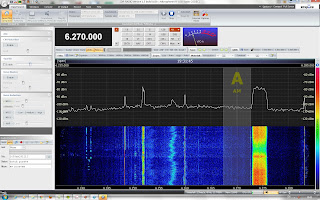
I have even managed to set the radio up so I can remotely tune and listen to it over the internet. If you visit SDRSPACE.COM and down load the software you will see a number of receivers that you can remotely use. Mine isnt on 24/7 at the moment though.
I will write further on the SDR4+ soon but for now I am enjoying tuning the bands with it.

It covers from around 900Khz to 30 Mhz and so far I am very impressed. In the main I have been using the SDR-Radio Software to control the radio.

I have even managed to set the radio up so I can remotely tune and listen to it over the internet. If you visit SDRSPACE.COM and down load the software you will see a number of receivers that you can remotely use. Mine isnt on 24/7 at the moment though.
I will write further on the SDR4+ soon but for now I am enjoying tuning the bands with it.
Saturday, 24 November 2012
Latest Addition

Latest addition to the shack is an "Isoterm Multicon USB" soundcard interface for PSK/DATA etc wired for my FT1000MP. Whilst I dont find the FT1000MP ideal for data modes it does allow me to clear a bit of space on the desk as the Kenwood FT450 I was using as a dedicated Data modes rig can now become a backup rig.
I am very Impressed with the construction of the unit and once I had downloaded the right driver for it all was quickly up and running. Trying a bit of PSK on 10 metres, running around 20 watts resulted in QSOs with VE3FGU and LU3CM.
Tuesday, 23 October 2012
40 Metres
A pleasant evening in the shack tonight. I had a couple of hours to spend and ended up having a few nice QSOs on 40 metres SSB.
I had a nice surprise when just as I was about to close down I was called by PC4T, fellow blogger Paul.
Its always nice to have a QSO with one of my Blog friends.
So thanks for calling in Paul. It was great to work you. Lets hope its the first QSO of many.
I had a nice surprise when just as I was about to close down I was called by PC4T, fellow blogger Paul.
Its always nice to have a QSO with one of my Blog friends.
So thanks for calling in Paul. It was great to work you. Lets hope its the first QSO of many.
Sunday, 7 October 2012
Antenna update
The "Western HF 10" antenna I recently install came with an information sheet recommending that it is installed with a centre support. At my QTH I have a small mast mounted on the back of the house and another at the end of my garden. In other words-no central support. The antenna although in itself lightweight has quite a large balun at the end of the 450 ohm ladderline.

I quickly found that if the balun was left hanging freely it put too much strain on the coax cable going into the balun. The result was the cable was pulled out of the PL259 connector requiring re-soldering.
 I have now installed a short support pole underneath the feedpoint of the balun and anchored the balun and the coax to it-that appears to have solved the problem.
I am very impressed with the antenna. It can be operated without an ATU on a portion of 80 metres and 20 and a large portion of 10 metres also. On the other bands down to 80 metres the internal ATU in my rig tunes it easily.The antenna seems very lively, especially on the higher bands. It will tune on 160 metres using an external ATU but signals on that band seem very low (The antenna is far too short for the band) and I think that anything other than local contacts on 160 would be unlikely.
It has coped well with the 300+ watts I have occasionally used when trying out the borrowed vintage KW1000 linear amplifier I have in the shack at the moment.
 As an added bonus this antenna seems very useful as a general shortwave listening antenna. I have hooked it up to my R5000 receiver and had some good results from around 3Mhz up to 30. On medium wave it does seem a little "deaf" obviously this is the same problem as 160 metres and I wouldn't have expected this antenna to work well on MW.
All in all as a compact antenna this one is really quite impressive and the quality of construction is excellent also.

I quickly found that if the balun was left hanging freely it put too much strain on the coax cable going into the balun. The result was the cable was pulled out of the PL259 connector requiring re-soldering.

I am very impressed with the antenna. It can be operated without an ATU on a portion of 80 metres and 20 and a large portion of 10 metres also. On the other bands down to 80 metres the internal ATU in my rig tunes it easily.The antenna seems very lively, especially on the higher bands. It will tune on 160 metres using an external ATU but signals on that band seem very low (The antenna is far too short for the band) and I think that anything other than local contacts on 160 would be unlikely.
It has coped well with the 300+ watts I have occasionally used when trying out the borrowed vintage KW1000 linear amplifier I have in the shack at the moment.

All in all as a compact antenna this one is really quite impressive and the quality of construction is excellent also.
Saturday, 22 September 2012
Antenna Work
Since I moved to this QTH I have not been that happy with my HF antenna. At first I put up a half size G5RV antenna and added an inductor to each leg to allow it to tune up on 80 metres. That lasted a few months but after a while the antenna wouldn't tune, try as I might i could not find out why, eventually I replaced it with a home made doublet.
After having my shed demolished I lost one of my antenna supports and for a while the far end of my antenna was simply tied to the fence.Earlier this year my next door neighbours were having some work done on their garden. They removed an old metal pole, 4 metres or so long which they had used to support a washing line. They offered me the pole, asking if it would be any use for my antennas. (I am lucky-I have good neighbours). Of course I accepted the pole and set about making use of it.
First I dug a hole at the end of the garden

And placed the old washing line post in it, filling the hole with concrete.


After having my shed demolished I lost one of my antenna supports and for a while the far end of my antenna was simply tied to the fence.Earlier this year my next door neighbours were having some work done on their garden. They removed an old metal pole, 4 metres or so long which they had used to support a washing line. They offered me the pole, asking if it would be any use for my antennas. (I am lucky-I have good neighbours). Of course I accepted the pole and set about making use of it.
First I dug a hole at the end of the garden

And placed the old washing line post in it, filling the hole with concrete.

I now had a "Stub mast" which would form the support for my new antenna pole.
I then ordered a hinged bracket from a seller on Ebay

Yesterday I had a 20 foot (approx 6 metre) thick walled aluminium pole delivered and today along with a local Radio Amateur friend we put the whole lot together to make a decent antenna support.

There is a pulley at the top of the pole so the antenna wire can be easily lowered or the whole pole can be easily dropped using the hinged bracket which is attached to the stub pole. We also installed a new HF antenna the "Western HF10 " which I bought some months ago.

Here you can see the shack end of the antenna (the wire is below the VHF/UHF colinear and above the TV antenna)
First impressions of the new antenna are good. It seems very lively particularly on the higher bands and I also had some good reports on 40 metres this afternoon. I will write more on this interesting antenna when I have had a chance to fully test it but it does seem a significant improvement on the previous wire.
Monday, 10 September 2012
Difficult programming
My holiday in
Cornwall a few weeks back went well, however there wasn’t much time for radio.
I did set up my FT857 and Buddistick antenna on a couple of
evenings but operating time was very limited and apart from the odd QSO on 20
metres not much was worked.
I also took my Chinese made dualband “Luiton” VHF/UHF handheld along hoping I might hear
some local activity on 2 or 70 cms. Before setting off I programmed a few local
repeater frequencies into the rig using my laptop PC and the software as
programming vis the rigs keypad is difficult to say the least.
Now the Luiton is identical to the more commonly seen TYT
UVF-1 the software, cable etc for the TYT all work on my Luiton.
Unfortunately due to a “slip of the mouse” I programmed a
wrong CTCSS code for the very repeater that was the loudest and closest to
where I was staying. “No problem” I thought I will just manually alter the
CTCSS using the rigs keypad and menu system. However there was no way I could
do this whilst I was away, I could access the menu setting for the CTCSS code
but it would not let me change the code. Putting the rig into VFO (as opposed
to memory) mode made no difference, I still could not alter the CTCSS. I still haven’t
found out why, the only option is now to reconnect the rig to the PC and see
what I can do. To add insult to injury only my ancient Windows XP laptop will
recognise the rig and adapter lead. The Win 7 PC in the shack won’t do it.
I have mentioned the “quirky” user interface of this handheld
before. The scanning facility on this rig is almost useless and some time had
to be spent using the software to adjust various settings before the TX audio
was at an acceptable level. The user friendliness of these rigs is really light
years behind that of the mainstream rigs from Yaesu, Icom and Kenwood etc. Yes
they are much cheaper and RF wise they seem to work OK but the are nowhere near
as easy to use.
I now see one of the Chinese manufactures is offering a
dualband mobile rig at a cost not that much less than the mainstream Japanese
manufacturers. I hope the user interface on these rigs is better, if it isn’t I
don’t think the established manufacturers will have much to worry about!

Subscribe to:
Posts (Atom)