Friday, 28 August 2020

Friday, 24 May 2019
160 metres
160 metres isn't really a band I have ever done much operation on. When I was first licensed I suppose I had the space for a decent 160m antenna but wasn't really interested in that band. These days space and local noise are the main problems. Having recently rediscovered WSPR I thought I would try 160 again.
Whilst my Drake MN4C tuner will tune my G5RV antenna OK, an evening on WSPR showed that the antenna was pretty useless on that band with nothing heard and nobody hearing me. In any case reception was all but impossible with S9+ of noise on the WSPR frequency.
Plan B was to insert a ground rod outside the shack (easy enough as my shack is on the ground floor) and strap the two sides of the G5RV together and tuning it against ground. The noise I experience on 160 at the moment is pretty bad, S9+ so receive is difficult. I did however manage to get my 10w WSPR signal out as can be seen below
 Additionally I managed to receive two German stations and one Swiss. I will experiment again with WSPR on 160, tonight I closed down just as darkness was closing in, a later session may enable some more distant reports. I would be happier running a maximum of 5 watts on this mode so will reduce power in future.
 So it seems it was worth hammering in that ground rod.................now if only I could trace the source of the noise.
Whilst my Drake MN4C tuner will tune my G5RV antenna OK, an evening on WSPR showed that the antenna was pretty useless on that band with nothing heard and nobody hearing me. In any case reception was all but impossible with S9+ of noise on the WSPR frequency.
Plan B was to insert a ground rod outside the shack (easy enough as my shack is on the ground floor) and strap the two sides of the G5RV together and tuning it against ground. The noise I experience on 160 at the moment is pretty bad, S9+ so receive is difficult. I did however manage to get my 10w WSPR signal out as can be seen below


Wednesday, 22 May 2019
6 Metres
When I first moved to this location, just over three years ago one of the first antennas I put up was a tri band 6/2/70cms vertical. I found it to be rather noisy on 6 metres and since I could only hear one 6 metre FM repeater, very noisily and there wasn't much else going on 50 mhz I took it down.
I replaced it with a dualband X30 vertical which being smaller I managed to get up higher in the air. The X30 works very well, as well as an antenna can work in this very poor VHF/UHF location in the bottom of a valley.
A couple of weeks back, when there was a sporadic E opening on 10 I found myself wondering whether 6 metres would be open too. I renmebered that I had a 6 metre dipole lying in my shed, one had had successfully used loft mounted in a previous location.
Today I dug it out, connected it to some spare RG8X cable I had and put it up outside. Its less than 5metres up at the moment but should work OK if the band opens.
 Since my main HF rig, the FT10000MP doesn't cover 6 I have put the Icom 7000 back on the operating desk for this band.
 Lets hope I haven't missed all the SP E openings this year!!!
I replaced it with a dualband X30 vertical which being smaller I managed to get up higher in the air. The X30 works very well, as well as an antenna can work in this very poor VHF/UHF location in the bottom of a valley.
A couple of weeks back, when there was a sporadic E opening on 10 I found myself wondering whether 6 metres would be open too. I renmebered that I had a 6 metre dipole lying in my shed, one had had successfully used loft mounted in a previous location.
Today I dug it out, connected it to some spare RG8X cable I had and put it up outside. Its less than 5metres up at the moment but should work OK if the band opens.


Radio on the cheap?

Despite the old saying "you get what you pay for" I have been pleasantly surprised with the handheld pictured above. Its a Baofeng DM-860 dual band VHF/UHF FM and DMR handheld.
Form factor is almost identical to the more expensive Radiodditty GD-77, in fact the batteries and chargers are interchangable between the two radios.although the programming lead and CPS software is different.
I have had this radio for a couple of months now and it has become my daily use handie. I have had good audio reports from it on both DMR and FM. Probably the best radio I have seen from Baofeng to date. It's not perfect obviously, the receiver on FM is not as good as my Icom ID51 for example but real world tests (i.e. using the radio) show it to be superior to both the Baofeng UV5R and RD5R.
At a price (direct from China) of just over £40 though it is hard to beat, particularly as it allows a degree of programming from the front panel which is not something all DMR radios allow.
Wednesday, 24 January 2018
really not real radio!
Just over two years ago I purchased an Icom ID-51 Dual Band
handheld radio. What was unusual for me about this radio was that it had D Star
Capability. This was a mode that had never interested me in the past after all
it wasn’t real radio as it depended on repeaters and or internet links to work.
However, at that time I was about to move house, had dismantled the shack and
taken down my antennas so I thought it would give me some radio interest to
occupy my time.
Two years on I still have the Dstar gear, have set up a
personal D star private node so I can work within a few Kms distance from my
shack when I am portable or mobile and using Dstar has also introduced me to
the delights of the Raspberry PI mini computer which I use with my node.
I have also obtained a DMR handheld, DMR equipment generally
is much cheaper than Dstar or the Yaesu digital mode Fusion. The problem with
DMR as it of course is a commercial mode and was never really designed for the
amateur market. Programming DMR rigs is a real nightmare (for me at least) but
I am learning.
I am also lucky enough to know a very generous amateur in our
local radio club that has loaned me a Yaesu Fusion Rig to try. So now I have
all three of the digital modes to hand.

Three modes, three radios- Icom ID 51-Dstar, Radioddity GD-77 DMR and Yaesu FT1D Fusion.
One thing all of these modes have in common is that they
rely heavily on the internet. Yes of course you could have simplex QSOs in any
of the three -Dstar, DMR or Fusion but generally this is not how these modes
are used. Most people are either working through a repeater or a personal node
or hotspot all of which use the internet as its backbone.
The three modes are incompatible and at present there are no
transceivers that operate more than one of these modes. So, if you want all
three you need three rigs! This also has the effect of diluting activity, as
some are on one mode, others on another.
Activity wise my Experience is DMR is marginally the most
active, followed by Dstar and lastly Fusion.
Whilst as I have written before it is fun to have Crystal
clear worldwide contacts from an armchair using a low power handheld it doesn’t
have the same magic as working HF or even FM on VHF. These days VHF 2 metres is
all but dead in this area, maybe these digital modes are to blame who knows?
But using these digital modes tied into the internet I suppose is no more magic
than a telephone call! That said I do use these modes from time to time. Who can deny how useful these systems would be
for someone who cannot put up antennas of any description but still wants to
keep in touch with other amateurs? The problem I believe is that there are
newly licenced amateurs who will never progress beyond their DMR handie and
experience the fun of the HF bands simply because its so easy!
Drake R8B- an old friend revisited (almost)
Back around 15 years ago or so I bought a Drake R8A
receiver. It was the first real top- flight receiver I had owned and I remember
being very impressed with it. I even used it with some PC software which back
then was quite a novelty being able to tune a radio using the PC. Eventually I
sold this receiver, I can’t remember why now but it was probably to fund some
new shack equipment. I regretted selling it soon enough but these receivers
seem fairly rare in the UK so I never managed to pick up another.
Although I have held an amateur radio licence for over 30
years and am active on the bands from time to time I have always been an SWL at
heart and always have a few dedicated receivers in the shack. In recent years I
have had receivers which were top of the range in their day. I still have an
Icom R70 and a Kenwood R5000 here, both still very good performers.
Just before Christmas however I spotted a Drake R8B on Ebay.
It was advertised as having a fault. That fault was that on switch on the radio
showed “PWRLOS” on the display. This is in fact not a fault, it simply means
that the receiver had been unplugged from the mains supply, the internal clock
has lost the time and needs resetting. If this was the only fault then there
should be no problems.
I took a gamble and bid and won the receiver. It didn’t sell
at a particularly cheap price but then again it sold for lower than I would
expect, no doubt due to the advertised “Fault”.
Well the receiver duly arrived and on unboxing it I found I
was lucky. Resetting the clock fixed things and I had an operating R8B. A quick
wipe with a cloth and a little polish and the receiver seemed in good
condition.

Well how does it compare to the other receivers I have? One
thing I had forgotten from my old days of Drake ownership. It dwarfs the R5000
and is substantially bigger than the Icom R70.

Build quality is not as good as either rig. It seems more flimsy than the R5000 and the R70 which is built like a tank! The Drake has a very light feeling VFO knob too!

Build quality is not as good as either rig. It seems more flimsy than the R5000 and the R70 which is built like a tank! The Drake has a very light feeling VFO knob too!
This may sound like I am disappointed with this set, but
actually I am not. The audio quality on the R8A once you plug in an external
speaker is superb. It has a good range of IF filters 6,4,2.3,1.8 and 0.5khz,
effective passband tuning and notch filter and synchronous AM detection. It would be ideal for a Medium Wave Dxer as it
has good sensitivity through the band. I also find the numeric keypad ideal for
navigating the bands just by punching in a frequecncy.It is also controllable
via a PC although getting suitable software for it these days will be a
challenge.
Saturday, 25 November 2017
Unusual Receiver
I picked up this receiver at a local radio rally a few weeks back. It is an RX80. It was made from a kit Featured in the RSGB magazine "Radcom" in 1981. It is amateur bands only but since it has a digital frequency readout I suppose it was quite advanced for its time. I have never seen one before and as you can see below this is a working example although the WARC bands (10 18 and 24 mhz )dont seem to function.
Radio Caroline
Radio Caroline seem to be testing their 648 Khz transmitter again. Good signal here in daylight hours in South Wales .
Sunday, 6 August 2017
GB5RC

I was pleased to be able to work special event station GB5RC from the Ross Revenge on 40 metres this morning. Having spotted a comment on Facebook saying they were operating on 7.141 I tuned in at around 0730 to hear them with a weak and watery signal. By 0830 the propagation had totally changed and they were coming into South Wales at S9+10. Congratulations to the team there who are operating a very busy station!
Tuesday, 11 July 2017
Cheap Radio
Although I have quite a few handheld radios I could not resist this pair of Baofeng 888s UHF radios.
Costing £19.00 (around 21 Euros or 24 US Dollars at today's rates) for TWO. A radio for £9.50 can't be bad can it?? Simple sets, 16 channels, no display, all must be programmed via PC.
This pair arrived with frequencies programmed in at 462Mhz and around, working back to back. I wonder how many get used on that frequency. Anyway safely programmed for the 70cms band the radios seem to access my local repeater ok.
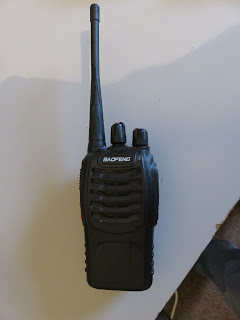 The BF888S
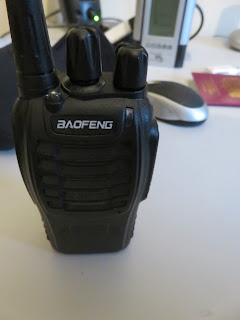 The charger has a USB connector, quite a neat idea I think.
 All programming of channels has to be done via PC, there is no way of doing it from the radio. There is specific software from Baofeng from this, screenshot below or you can use CHIRP

Costing £19.00 (around 21 Euros or 24 US Dollars at today's rates) for TWO. A radio for £9.50 can't be bad can it?? Simple sets, 16 channels, no display, all must be programmed via PC.
This pair arrived with frequencies programmed in at 462Mhz and around, working back to back. I wonder how many get used on that frequency. Anyway safely programmed for the 70cms band the radios seem to access my local repeater ok.


Thursday, 15 June 2017
Mobile!
I changed my car just over a year ago. My previous car an elderly Volvo S40 was approaching 200,000 miles and was beginning to show its age. I had an Icom 706 MK1 in that car for HFas well as a Kenwood TMG707 for VHF/UHF. Fitting the gear was easy enough with space in the centre console for the two head units.
The replacement car a "second Generation" Volvo S40 (an old car in itself- a 2005 model) was a different proposition for radio. In the old Volvo there was a double DIN sized stereo, removing this left a space for a replacement single DIN CD/Radio as well as a space for a radio head unit. In the newer S40's there is no way of removing the stereo, it is built into the centre console and also controls the Aircon, heating etc.
I quickly realised HF would be difficult to install in this car so I settled on a dual band Icom 880 rig for VHF/UHF and it also has D star Capability. The body of the rig is installed under the driver's seat with the remote head mounted on a "Proclip" clipped to the centre console. the clip is a bespoke design for the S40 intended for use with a mobile phone but works just as well with the 880 head unit.
 With the addition of a boot mounted dual band whip I am now back on the air mobile!
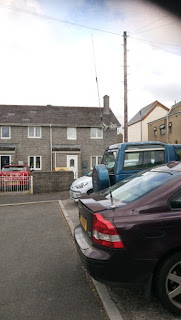
The replacement car a "second Generation" Volvo S40 (an old car in itself- a 2005 model) was a different proposition for radio. In the old Volvo there was a double DIN sized stereo, removing this left a space for a replacement single DIN CD/Radio as well as a space for a radio head unit. In the newer S40's there is no way of removing the stereo, it is built into the centre console and also controls the Aircon, heating etc.
I quickly realised HF would be difficult to install in this car so I settled on a dual band Icom 880 rig for VHF/UHF and it also has D star Capability. The body of the rig is installed under the driver's seat with the remote head mounted on a "Proclip" clipped to the centre console. the clip is a bespoke design for the S40 intended for use with a mobile phone but works just as well with the 880 head unit.


Friday, 2 June 2017
10 Metres

Working at home today and taking a quick tea break I flicked the rig onto 10 metres. One or two stations around and I managed a quick QSO with HB3YGG, Victor. My only HF transmit antenna at the moment is the full size G5RV.
I would like to try a 10 metre vertical from this QTH as I found the Antron 99 which I used from my previous QTH to work very well on 10 and 12 metres. I have a Hygain AV12 vertical lying in the shed which covers 10-15-20 maybe I should get that up?
Thursday, 23 February 2017
Real Radio?

Almost 18 months ago I was getting ready to move home. All my radio antennas were taken down ready for the move apart from my Wellbrook loop which was mounted on a short pole in the garden and could be removed at the last minute. so I could listen on shortwave but that was all.
In preparation for this I had purchased an Icom ID-51 Handheld radio. This is a dual band VHF/UHF Handie which also has D Star Capability. Now in the past I had not really been attracted to the idea of D Star as it depends on either using repeater, the internet or both. But I convinced myself that it would allow me some form of communication whilst I had no antennas and no proper shack.
Along with the Icom Handheld I bought a "DV Mega" hotspot, basically a miniature transceiver with an output of 10mw which connects to your PC (or Raspberry PI- more on PI's later) and transfers the RF from the handie onto the internet and vice versa.
Well It took me some time to set all this up and get it working- D Star seemed like a mystery to me at first and I won't bore you with all the details but eventually i got the system running OK. And yes it is quite a novelty to speak to other operators all over the world using a handie. I can see how this system is a godsend to Radio Amateurs who find themselves unable to put an antenna up or perhaps are travelling and operating from hotels and so on. It does however lack the "magic" of a direct HF contact and in my opinion isn't real radio in the true sense. Take away the internet and you are just left with a short range handheld.
Now I am in my new QTH, I have set up my shack and some simple antennas and am back on the air. I still have the d Star equipment of course and yes I still use it. It is fun to be walking the dog and working Puerto Rico on a UHF handheld as I did the other day. Using the system has also introduced me recently to the joys of a Raspberry Pi computer and the Linux OS so it has provided a learning opportunity.
But "Real Radio"- its not- as long as we use it as an addition to the hobby and not as our main activity I see no harm in systems like D Star and DMR. We just should remember that its a good idea to retain communication systems that are not internet dependent.
Sunday, 12 February 2017
Radio History?
A little while after moving to this QTH I joined the local radio club. Always a good way of getting to know local radio amateurs in a new area and an opportunity to chat to like minded people and share knowledge. One evening I mentioned that I used a few SDR receivers in the shack. A number of the club members were not familiar with SDR and to cut a long story short I ended up offering to bring along a couple of my receivers and give a demonstration.
Whilst I was planning my demo I realised that as the club meetings are in the evenings and HF conditions have been very poor lately it was quite possible that we would have very little to listen to. Then it occurred to me- Most SDR software has a facility to record. Not simply to make an audio recording, although it can do that as well as required. The clever bit about recording from an SDR receiver is that you can also "record" a whole bandwidth of signals. In the case of my Elad SDR radio it can receive and record up to 6mhz of bandwidth. The picture below shows it receiving the full 6mhz using the SDR console v3 software.

Whilst I was planning my demo I realised that as the club meetings are in the evenings and HF conditions have been very poor lately it was quite possible that we would have very little to listen to. Then it occurred to me- Most SDR software has a facility to record. Not simply to make an audio recording, although it can do that as well as required. The clever bit about recording from an SDR receiver is that you can also "record" a whole bandwidth of signals. In the case of my Elad SDR radio it can receive and record up to 6mhz of bandwidth. The picture below shows it receiving the full 6mhz using the SDR console v3 software.

Using this facility I was able to record part of the spectrum in the daytime, when the bands were busy and use this to demonstrate the SDR software and receivers.
The received part of the spectrum can be recorded onto a hard drive (or any other media). When played back you can tune through the spectrum (in the example above from around 11 to 17 mhz) using whatever mode you want.
In effect you have a snapshot of that bit of the HF spectrum which you can listen to as if you were sat at your receiver when the recording was taken.
This set me thinking, if only we had this technology years ago. Today we would be able to tune through the HF bands of the 40s,50's 60's as if we were there!
I wonder if anyone is recording the bands on a large scale now. The downside of this is at the moment these recordings use a lot of space. The recording in my picture above was for a 10 minute recording of 6mhz of spectrum which used 7gb of storage. I reckon to record the whole 30mhz of LF/HF (if you had a receiver with such a wide bandwidth) for 24 hours would use in the region of 8.4 tb. If you were attempting to record for any length of time you would need a massive amount of storage. But just imagine if we were able to tune through the bands of yesteryear!........................................
Sunday, 14 August 2016
It's Been a long time but.............
I am still active. The blog has been neglected, I kept meaning to update it but have only just found the time. I moved QTH at the end of January this year and have been busy with lots of things. Once I had unpacked at the new place I wanted to set up a basic station.Initially I set up an HF station with my Icom 7000 and a very temporary half sized G5RV inverted V held up by a fibreglass pole at about 6 metres high.

7 months later, you guessed it, the "temporary" antenna is still there! It has however been joined by my 6/2/70cms vertical (which needs to go a little higher)

and two antennas for SWL, my trusty Wellbrook loop

and a "Boni Whip" active antenna

Here it is in place, well for the moment at least. If all is well with it I will be getting some self amalgamating tape on those connectors. The Boni Whip is an adaptation of the mini-whip designed by PA0RDT. I bought this antenna a couple of years ago but with the awful noise problems I had at my old QTH never bothered to put it up. I thought I would try it here. The whip on the antenna is tiny, maybe around 7cms but initial results seem encouraging, it is particularly good on the lower bands. There is some debate on line as to whether the antenna should be grounded or not. I found mine to be much quieter noise wise after I did this.

And here it is on top of its mast.

Sunday, 29 November 2015
QRT? Not Quite
I haven't posted here for quite a while. Its not that I have lost interest however the shack has largely been dismantled and most of the antennas taken down as I am waiting to move house. Of course these things take time and even if all goes to plan it may be a few months before I am at my new QTH. In the meantime the only antenna still in use is my Wellbrook active receiving loop along with a couple of receivers in the shack. So for now I am almost totally an SWL. This would not be so bad if I didn't have a very bad noise problem here. I have been unable to trace this noise. It disappeared for a couple of months in the summer, but now its back. I don't think it comes from my neighbours properties as a while back we had a power cut in the street and checking with a battery powered receiver the noise was still there. The noise it at its worst below about 7 mhz, it wipes out parts of the medium wave, as well as the 160m and 80 metre bands and affects 40metres to a lesser extent.
Here's an example of the effect on medium wave.
I am just hoping my new QTH will be a bit quieter on HF!!
I still have 2 metres FM and HF on my Icom 706 in the car so can operate mobile however 2 metres in this area is a wasteland with very little activity. With the house move and the prospect of no antennas for a while I have even got involved in an area of radio that I had always been rather critical in the past- D-STAR. I will talk more about this in future blogs, it is a way of still getting some radio activity in at the moment but it is cheating and doesn't of course have the same magic at operating on HF!
Here's an example of the effect on medium wave.
I am just hoping my new QTH will be a bit quieter on HF!!
I still have 2 metres FM and HF on my Icom 706 in the car so can operate mobile however 2 metres in this area is a wasteland with very little activity. With the house move and the prospect of no antennas for a while I have even got involved in an area of radio that I had always been rather critical in the past- D-STAR. I will talk more about this in future blogs, it is a way of still getting some radio activity in at the moment but it is cheating and doesn't of course have the same magic at operating on HF!
Sunday, 16 August 2015

I had a little time to play radio this weekend so managed to work a few special event stations that were running for the lighthouse weekend. Conditions were not that good and the noise problem I still have here doesn't help but I managed a few. One surprise was working EI0LHL on 20 metres. I can't remember ever working an EI on 20 before, the skip isn't usually that short on that band.
The noise problem here is very strange. A few weeks back we had a power cut in this area. Listening around on a battery operated radio at that time showed the noise was still there. So my noise is not caused by a near neighbour with a PLT device as I had suspected. Stranger still about two weeks ago the noise disappeared. Sadly it is now back again but perhaps isn't quite as bad as it was but it still makes a mess of Top Band (160m) and Medium Wave.
Tuesday, 16 June 2015
6 Metres
Caught my first six meter opening of 2015. Some pretty strong signals on the band when I switched on around 1930 UTC. Managed to work a few with just 50 watts from the Icom 7000 to my vertical. Nothing spectacular but it was nice to work Italy, Spain and France on 6 metres.Switching on the "radio" computer to enter the calls in my electronic log I found the computer had died! I havent time at the moment to investigate the problem but this PC is quite old and in fact was given to me for free. Possibly time for an upgrade I think. In the meantime I am glad I still keep a paper log in the shack.
Saturday, 6 June 2015
A new (but old) addition
Here is the latest addition to my Shack. As a young shortwave listener in the 1980's I always wanted one of these receivers but back then it was of course well out of my price range. It is the Icom R70
 I managed to get an immaculate example of this receiver at a reasonable price and I am very pleased with it. It is a heavy, well built set, it feels far more substantial than the Kenwood receivers I have from the same era.
It is however quite a quirky receiver in some ways. Each time you turn the receiver on it defaults to the same frequency (15mhz in general coverage mode and 7 mhz in HAM mode). In addition you tune in 1 MHZ bands and you must use the UP and DOWN buttons to go to the next Mhz segment. In other words if you are at 7.999 Mhz and keep tuning, rather than go up to 8.000mhz the R70 rolls back down to 7.000mhz. Quite an odd way of doing things. Still as an HF receiver the R70 is excellent and I think this one is a "keeper".

It is however quite a quirky receiver in some ways. Each time you turn the receiver on it defaults to the same frequency (15mhz in general coverage mode and 7 mhz in HAM mode). In addition you tune in 1 MHZ bands and you must use the UP and DOWN buttons to go to the next Mhz segment. In other words if you are at 7.999 Mhz and keep tuning, rather than go up to 8.000mhz the R70 rolls back down to 7.000mhz. Quite an odd way of doing things. Still as an HF receiver the R70 is excellent and I think this one is a "keeper".
Wednesday, 8 April 2015
Silent Keys
Its never good in this hobby of ours to see the words "Silent Key". In this case the Amateur was not known to me (He was a relative of a work colleague) and in fact he has passed away over three years ago. I was asked to help his widow value and dispose of the radio gear.
I found a well equipped station with An 200watt Yaesu FT1000mpMk5, A Kenwood TS870s (having tested it here I am very impressed and various other transceivers. All in good condition and as I later found in good working order. I was told in passing by the silent key's XYL that one of her relatives had advised her to simply throw the gear in the radio shack away! Luckily she knew enough to realise that this was not a good idea. It did make me wonder however how much gear is potentially destroyed like that. There were also one or two less valuable but perhaps more interesting pieces of gear:

This Sony ICF2001D was a state of the art portable maybe 20 years ago or more. This one was in very good condition and its still an excellent receiver. This one has been added to my shack!
What is in this box?
 Its actually a multimeter, A CT471C I think used by the military (possibly the Royal Air Force?)
 Here it is with the lid removed.
 Inside the lid are the test leads and some sort of probes.
This is a heavy unit, not like the little lightweight plastic multimeter I have!
For VHF/UHF there was a Yaesu FT4700RH dual band rig. Although this was quite an old radio I was surprised to find it had a CTCSS unit fitted and it appeared more sensitive on receive than my Icom IC7000

As radio hobbyists we know that all of this equipment has a value. We may not know exactly how much each item is worth but we would have an idea or, at least, an idea of where to find out. It is easy to forget that to people who have no interest in the hobby (this may include relatives/loved ones) may not realise that this equipment is worth anything. To the untrained eye this is "junk" metal boxes that could be thrown out.
Equally there are people out there perhaps less than honest that may take advantage and clear shacks out paying only a fraction of the true value. What can we do about this? Perhaps list the main equipment we have and let those close to us know that some of this equipment is valuable .
I found a well equipped station with An 200watt Yaesu FT1000mpMk5, A Kenwood TS870s (having tested it here I am very impressed and various other transceivers. All in good condition and as I later found in good working order. I was told in passing by the silent key's XYL that one of her relatives had advised her to simply throw the gear in the radio shack away! Luckily she knew enough to realise that this was not a good idea. It did make me wonder however how much gear is potentially destroyed like that. There were also one or two less valuable but perhaps more interesting pieces of gear:
This Sony ICF2001D was a state of the art portable maybe 20 years ago or more. This one was in very good condition and its still an excellent receiver. This one has been added to my shack!
What is in this box?
This is a heavy unit, not like the little lightweight plastic multimeter I have!
For VHF/UHF there was a Yaesu FT4700RH dual band rig. Although this was quite an old radio I was surprised to find it had a CTCSS unit fitted and it appeared more sensitive on receive than my Icom IC7000
As radio hobbyists we know that all of this equipment has a value. We may not know exactly how much each item is worth but we would have an idea or, at least, an idea of where to find out. It is easy to forget that to people who have no interest in the hobby (this may include relatives/loved ones) may not realise that this equipment is worth anything. To the untrained eye this is "junk" metal boxes that could be thrown out.
Equally there are people out there perhaps less than honest that may take advantage and clear shacks out paying only a fraction of the true value. What can we do about this? Perhaps list the main equipment we have and let those close to us know that some of this equipment is valuable .
Subscribe to:
Posts (Atom)